An investment of approximately 2 million euros is set to be implemented in the coming days by “Artima A.E.”, to double its facilities in Nea Magnisia, Thessaloniki, having to present an increase in sales in 2020, the year when the global economy was hit due to the pandemic.
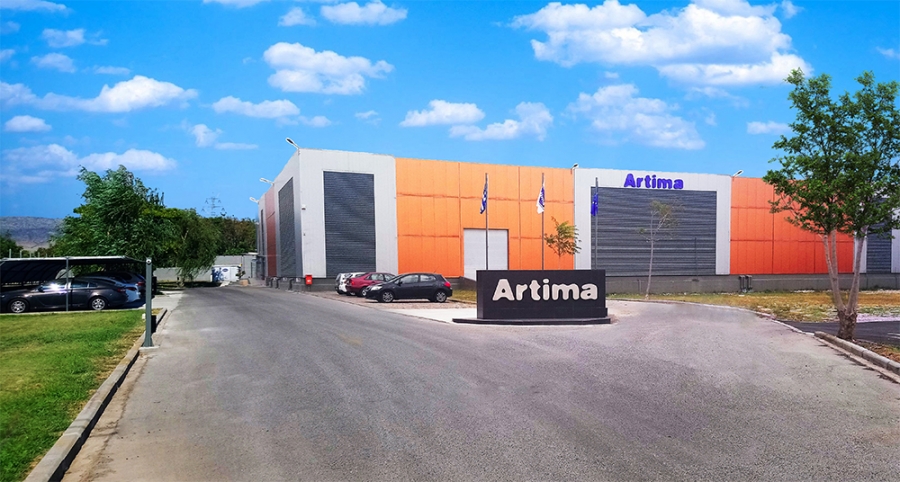
The company, within three years from its previous investment in the Nea Magnisia complex, is investing from its own resources to double its facilities, adding 2,500 sq.m. to the existing 3,000 sq.m., in order to create additional refrigerated spaces as well as dry cargo.
“We have never received a single subsidy. Three years ago we employed 35 staff and during the crisis we more than doubled our staff, resulting in employing 85 people today. Everything we do is done with the company’s resources. In five days, the works will begin and the expansion will be completed in six months, by the end of summer,” said Mr. Giorgos Akritidis, president and CEO of the Company, to GRTimes.gr.

The company, since its establishment in 2006, has not received a single subsidy and is developing independently. The founders and shareholders with equal shares are Mr. Giorgos Akritidis and Mr. Dimitris Papadopoulos.
“Artima” is one of the businesses that “benefited” from the coronavirus, as the increase in sales to supermarkets was so significant that it covered the losses in the HORECA market.
Supermarkets and Revenue Increase
“Artima A.E.” is a company that manages many Greek and imported dairy products (imports, packages, trades), placing great emphasis on private label, both for chains in Greece and abroad. It is the largest company based in Thessaloniki in the trade of dairy products. The business is strong in organized retail, as well as in the HORECA market, with a turnover of 39 million euros in 2020, compared to 33.5 million in 2019 (+16.4%), while last year’s profits after taxes are estimated at 1.8 million euros.
A large portion of “Artima’s” sales takes place in the Greek market, but the company also exports, which last year amounted to 3 million euros. Mainly, cheeses are exported to Cyprus, Bulgaria, Germany, England, Albania, and Poland. The exports do not only concern Greek products but also imported ones. Thus, “Artima” exports Dutch cheeses for the industry “Charalambidis Christis” in Cyprus, while also making sales for “Afoi Petrou”, that is, for the two largest Cypriot dairy companies.
Cheeses Account for 60% of Revenue
“Artima” trades cheeses, butters, and milk, under two brands, “our mountain” and “royal”, with cut and packaged cheeses representing a very significant part of its activity as they account for 60% of its turnover. It should be noted that in the turnover of dairy products, Greek cheeses – many of which are PDO – have a share of about 30%.
“Artima emphasizes private label, as these products, although they have a share of only 16% in organized retail, are gaining ground and there are significant growth opportunities”.
Having been active for many years in the dairy – cheese market, Mr. Akritidis refers to differentiations and trends that affect demand and shape the rich product mix of this specific market.
Market and New Trends
“In recent years, there has been a perception among consumers that products made from goat’s milk are healthier. Thus, we have a plethora of cheeses and yogurts made solely from goat’s milk. We also see, for example, the return of tsantila cheese, a traditional method of preparation that has been ‘neglected’ for years.
“Undoubtedly, we observe an enrichment of the range of Greek cheeses in the supermarkets of northern Greece, which is also due to the fact that chains based in Attica have strengthened their position in the northern Greek market. It was expected that the rest of the retail sector would follow.
“I should also note that in the last decade we have many low-fat products while beverages made from soy and nuts have also been placed in the market alongside milk,” said Mr. Akritidis, adding:
“It is clear that there have been significant differentiations in the dairy products market, especially in cheeses. Products with reduced fat in cheeses now account for about 20% of sales, a trend that has contributed to the reshaping of the market”.
In conclusion, the CEO of “Artima” emphasized that 2021 also started with a positive sign in sales, which in the first two months of the year recorded an increase of about 10%. Now expectations are focused on the decline of the coronavirus, the restart of the catering and tourism sectors, and the opening of the HORECA market.